Exploring the Tesla Coil: A Spark of Innovation
4/9/20258 min read
Introduction to the Tesla Coil
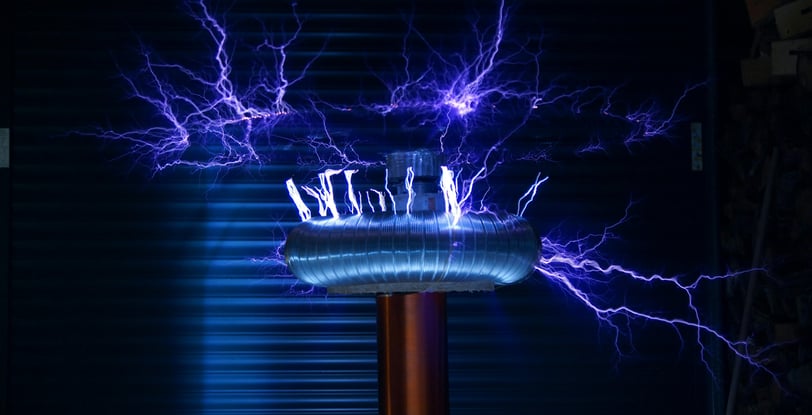
The Tesla Coil is a transformative invention developed by Nikola Tesla in 1891, which has significantly influenced the field of electrical engineering. At its core, the Tesla Coil operates on the principles of high-frequency alternating current (AC) and resonant transformers. This device is capable of generating high-voltage, low-current, high-frequency alternating current electricity, which allows it to produce spectacular electrical discharges and sparks.
The fundamental operation of the Tesla Coil involves two main components: the primary coil and the secondary coil. The primary coil is energized by a power supply, creating a magnetic field that induces a current in the secondary coil. Due to its design, the secondary coil is capacitively coupled with the primary and operates at a resonant frequency that amplifies the voltage. This resonance leads to the dramatic electrical phenomena associated with Tesla Coils, including lightning-like arcs and impressive electrical displays. These characteristics have captivated enthusiasts and researchers alike, highlighting its potential applications and further innovations.
The significance of the Tesla Coil extends beyond its remarkable visual display; it has played a pivotal role in the development of various technologies, including radio transmission, medical devices, and wireless energy transfer. Its ability to transfer electrical energy without physical connections has inspired numerous advancements in wireless technologies, marking a vital step in the evolution of modern electrical systems.
In exploring the Tesla Coil, it becomes evident that Tesla's innovation sparked not only a fascination with electricity but also laid the groundwork for future electrical advancements. Its impact continues to resonate in contemporary technologies, demonstrating the enduring legacy of Tesla's visionary contributions to electrical engineering.
Historical Context of Tesla's Innovations
Nikola Tesla, born on July 10, 1856, in Smiljan, Croatia, emerged as one of the most significant inventors and visionaries of the late 19th and early 20th centuries. His life unfolded during a transformative period marked by rapid advancements in technology and science. The late 1800s was characterized by the growing adoption of electricity, with inventions such as the electric light bulb by Thomas Edison and the development of early telegraphs. However, much of this technology was still in its infancy, and many challenges related to electrical systems remained unsolved.
Tesla's genius shone through his numerous inventions and experiments that preceded the creation of the Tesla Coil in 1891. After moving to the United States in 1884, he initially worked for Edison but soon parted ways due to conflicting ideas about electricity. While Edison championed direct current (DC), Tesla believed in the superiority of alternating current (AC). His innovative approach to electrical systems led to the design of the AC motor and transformer, which significantly improved energy transmission efficiency.
The technological landscape of Tesla's era was ripe for disruption, as conventional methods limited power distribution and created significant losses in energy efficiency. Tesla's work not only challenged the status quo but also paved the way for modern electricity utilization. The Tesla Coil, a high-voltage resonant transformer circuit, became one of his most notable inventions, showcasing his groundbreaking research on high-frequency alternating currents and wireless transmission. This device not only illustrated Tesla's innovative spirit but also laid the groundwork for numerous applications in communications and medical technologies that would emerge in later years.
Thus, Tesla's historical context reveals a confluence of personal ambition, scientific inquiry, and technological necessity. These elements combined to form the foundation of inventions that would revolutionize how electricity is harnessed and utilized, fundamentally changing the landscape of modern society.
How Tesla Coils Work
The Tesla coil is an electrical device that relies on resonant inductive coupling to generate high-voltage, low-current, high-frequency alternating currents. Central to its operation are two primary components: the primary coil and the secondary coil. These coils are vital in creating the necessary electromagnetic fields that facilitate the transfer of energy. The primary coil is typically made from a few turns of heavy wire and operates at a lower voltage, while the secondary coil consists of many more turns of finer wire and is designed to produce much higher voltages.
At the core of a Tesla coil’s functionality is its capacitor. This component is essential in storing and releasing electrical energy. When voltage is applied to the system, it charges the capacitor until it reaches a critical threshold. At this point, the energy stored in the capacitor discharges through the primary coil, generating a magnetic field. This rapid change in magnetic field induces a current in the secondary coil due to electromagnetic induction, a phenomenon described by Faraday’s law.
Moreover, the spark gap plays a crucial role in the operation of a Tesla coil. Located between the primary coil and the power source, the spark gap allows the current to discharge from the capacitor into the primary coil. This process can create a series of electrical discharges, forming a feedback loop that sustains oscillation. The resonance between the primary and secondary coils amplifies the induced current, resulting in impressive voltage levels capable of generating high-voltage arcs of electricity.
Visual aids and diagrams can elucidate these mechanisms further, illustrating how each component interacts within the system to produce the striking electrical phenomena characteristic of Tesla coils. Understanding this intricate operation highlights the engineering ingenuity of Nikola Tesla, whose vision continues to inspire modern innovation.
Applications of Tesla Coils in Modern Technology
The Tesla coil, a resonant transformer circuit invented by Nikola Tesla in the late 19th century, has transcended its initial purpose and developed a multitude of contemporary applications. One prominent use of Tesla coils is in the field of radio transmission. By generating high-voltage, high-frequency alternating currents, these devices can create electromagnetic fields that allow for the transmission of radio waves. This property has made them valuable in the development of early radio transmitters, and their principles continue to influence modern communication technologies.
Another significant application lies in the realm of wireless energy transfer. Tesla envisioned a world where electricity could be transmitted without the need for cumbersome wires, and although we have yet to fully realize this dream, Tesla coils have paved the way for advancements in wireless power systems. Today, they are utilized in various experimental designs aimed at efficiently delivering power to devices without physical connections, thereby enhancing convenience and efficiency in energy usage.
Moreover, Tesla coils play a crucial role in high-voltage experiments, particularly in research laboratories and educational settings. They are employed to generate high-voltage discharges, which can be vital for studying electrical phenomena and the behavior of gases under electrical influences. In these settings, Tesla coils provide a safe and controlled environment for conducting experiments that investigate the properties of electricity and plasmas.
In addition to practical applications, Tesla coils have found their niche in art and entertainment. Known for their dramatic arcs of electricity, they are frequently incorporated into musical performances and theatrical productions. Artists use Tesla coils to create visually stunning displays that resonate with Tesla's visionary ideas about the beauty and potential of electricity, thus not only showcasing technological advancement but also paying homage to the groundbreaking work of Tesla himself.
Tesla's Broader Innovations and Contributions
Nikola Tesla, a formidable figure in the realm of electrical engineering, transcended his groundbreaking work with the Tesla Coil through numerous significant innovations that have fundamentally shaped modern technology. Central to his legacy is the development of alternating current (AC) power systems, which revolutionized the way electricity is generated, transmitted, and utilized. Unlike direct current (DC), the AC system enables efficient long-distance energy transmission, making it feasible to power entire cities from a single source. This foundational system laid the groundwork for the widespread adoption of electricity in homes, businesses, and industries, thereby transforming daily life.
In addition to AC power systems, Tesla's invention of the induction motor marked another pivotal advancement in electrical engineering. This device operates on principles derived from electromagnetism, enabling efficient conversion of electrical energy into mechanical energy without the need for brushes or commutators. The induction motor not only increased the efficiency of industrial machinery but also played a significant role in the automation of manufacturing processes, heralding a new age of industry and commerce.
Moreover, Tesla's contributions to wireless communication are noteworthy. Through his experiments with radio waves, he pioneered concepts that would later pave the way for advancements in wireless technology, such as radio broadcasting and telecommunications. Tesla's vision of a global communication system foreshadowed the interconnected world that we inhabit today. His inventions in this area not only exemplify his understanding of electromagnetic principles but also his foresight regarding the future of communication.
Overall, Tesla's innovations in AC power systems, induction motors, and wireless communication showcase the profound impact of his work on the various facets of modern technology. Each of these contributions underscores Tesla's remarkable ability to harness the principles of electromagnetism, illustrating his enduring legacy as a pioneer in electrical engineering and a visionary thinker.
The Cultural Impact and Legacy of Tesla
Nikola Tesla, a pioneer in electrical engineering, has left an indelible mark on both the technological landscape and popular culture. His innovative contributions, particularly the Tesla Coil, have inspired generations of inventors, engineers, and even artists. As a symbol of creativity and innovation, Tesla embodies the spirit of exploration and ingenuity that characterizes advancements in science and technology.
The Tesla Coil itself, an invention designed for wireless transmission of electricity, is emblematic of Tesla's visionary approach to energy. This device has not only paved the way for numerous technological developments but has also captured the imagination of the public. From its use in educational demonstrations to its portrayal in various media, the Tesla Coil stands as a testament to the limitless possibilities that Tesla envisioned. It serves as a reminder that the convergence of science and art can spawn remarkable innovations.
In popular culture, Tesla has emerged as a fascinating figure whose legacy transcends the confines of technological circles. Numerous films, books, and art installations celebrate his work, often highlighting his eccentric personality and enduring contributions. As a result, Tesla’s image has transformed from that of a misunderstood genius to a cultural icon, inspiring movements that advocate for scientific exploration and sustainable energy solutions.
The resurgence of interest in Tesla in the digital age is notable, with social media platforms and online communities devoted to sharing his ideas and inventions. This renewed focus has created a vibrant space where individuals can engage with Tesla’s theories, making his work accessible to a new generation of enthusiasts. Ultimately, the enduring legacy of Nikola Tesla is a powerful reminder that innovation is not merely the result of technological advancements but also a cultural movement that encourages creative thinking and daring exploration.
Building Your Own Tesla Coil: A Beginner's Guide
Constructing your own Tesla Coil can be an exciting and educational project that allows enthusiasts to engage with the principles of electromagnetism and high-voltage systems. However, it is essential to approach this endeavor with caution and a fundamental understanding of the associated risks. Safety should always be your top priority. Thus, before starting your project, familiarize yourself with high-voltage safety protocols. Working with Tesla Coils can result in hazardous electrical discharges, which necessitate proper safety gear such as insulated gloves and goggles, and a workspace devoid of conductive materials.
Once safety measures are in place, you can gather the necessary materials to build your Tesla Coil. Essential components typically include a high-voltage power supply, capacitor banks, and a spark gap. Copper wire is crucial for winding the primary and secondary coils, where the magical effects of electromagnetic induction will occur. It is advisable to reference detailed plans or schematics, which provide precise dimensions and arrangements for the components. Online resources and communities focused on Tesla Coil construction can provide valuable insights and support.
The construction of a Tesla Coil can be broken down into several key steps:1. **Build the Primary Coil**: Wind copper wire around a cylindrical form, ensuring even spacing.2. **Create the Secondary Coil**: Similar to the primary coil, but this coil will have many more turns of wire, typically wrapped around a longer cylinder.3. **Setup the Spark Gap**: Position two electrodes to create an air gap where electricity can jump.4. **Connect the Capacitor Bank and Power Supply**: Ensure that these components are securely wired and able to handle the voltage produced.5. **Finalize and Test**: Make sure all connections are secure and conduct a low-power test before moving to higher voltages.
By following these fundamental guidelines, hobbyists can build their own Tesla Coil and explore the fascinating world of high-voltage electricity. Emphasizing safety and proper technique will ensure a rewarding experience while diving into the remarkable legacy of Nikola Tesla.